5 Hidden Features of the Ninja Crispi Pro You Must Know About
Introduction
The Ninja Crispi Pro frequently appears on shoppers' radar as a high-performance countertop cooker that promises restaurant-style crispiness without the deep-fat frying. While buyers often focus on capacity, wattage, and the usual preset buttons, several underappreciated features make the Crispi Pro a more versatile tool than it first appears. This article uncovers five of those hidden features, explains how they help in real kitchens, and offers practical buying and usage guidance for readers who want to get the most out of this appliance.
Why these hidden features matter
Many people buy an air cooker for convenience and speed, but they quickly discover that what separates a good result from a great one is control, workflow, and clean-up. The Ninja Crispi Pro's subtle design and software elements address these real-world concerns: crisp texture without soggy middles, the ability to cook different foods simultaneously, consistent doneness with minimal babysitting, and fast cleanup after busy weeknights. Understanding the lesser-known capabilities turns the appliance from a single-use gadget into an everyday kitchen workhorse.
Detailed product review and analysis
The review below focuses on five specific features that users tend to overlook when they first unbox the Ninja Crispi Pro. Each section explains what the feature is, why it matters, and how to use it in real-world scenarios such as weeknight dinners, meal prep, and reheating leftover takeout.
1. Two-stage crisping: temperature ramping and finishing blast
At first glance, air cookers look like high-speed convection ovens. The difference that matters is how they manage the final texture. The Crispi Pro offers a two-stage approach that many cooks miss: an initial controlled cook that brings food up to the right internal temperature, followed by a short, high-heat "finishing blast" that crisps the exterior.
Why it matters: this strategy prevents over-browning while ensuring a crisp finish. For example, bone-in chicken needs longer time to reach safe internal temperature; a continuous high-heat cook can char the skin before the meat is done. The two-stage method yields juicy chicken with evenly crisp skin.
How to use it in practice:
- Start with the default cook time for the item (e.g., 20–25 minutes for frozen fries or 18–22 minutes for medium-sized chicken thighs).
- When the internal temperature is near target, activate the high-heat finish for 2–4 minutes depending on how dark and crunchy one prefers the exterior.
- For frozen items, giving a short shake halfway through the cycle helps; for thicker cuts, use a probe (if available) to monitor internal temperature before the finishing blast.
2. Multi-rack cooking with engineered airflow
Most air cookers are assumed to work best with a single tray. The Crispi Pro's interior design and included racks are optimized for multi-level cooking, allowing two trays to cook different items simultaneously with surprisingly even results.
Why it matters: this expands the appliance’s utility beyond single-item batches. A single appliance can produce a protein and a side at the same time—think salmon filets on the lower rack and roasted asparagus on the upper rack—cutting total cook time and saving energy.
Real-world tips:
- Arrange items by thickness and required finish: thicker items should be placed on the lower rack closer to the heat source, while thinner or delicate items go on the top rack.
- Stagger finish times—if the top rack food needs less crisping, remove it early and let the bottom rack finish.
- Rotate trays if the appliance recommends it mid-cycle, and avoid crowding both trays to maintain airflow.
3. Probe compatibility and smart timing
One of the most undervalued features in many countertop cookers is probe compatibility. When used, a probe provides direct feedback on internal temperature so the device can prioritize food safety and precise doneness instead of relying solely on timers.
Why it matters: probe-driven cooking turns guesswork into certainty. This is especially helpful for busy households that want to set-and-forget bone-in roasts or poultry. Rather than overcooking to be safe, a probe helps achieve the exact level of doneness—useful for roast chicken, pork tenderloin, or thick steaks.
Shop the latest Electronics picks on Amazon.
View Offers →How cooks use it in everyday scenarios:
- Insert the probe into the thickest part of the meat, away from bone or fat. Set the desired internal temperature and let the Crispi Pro alert or automatically adjust to finish with a crisping stage.
- For meal prep, set temperature-based notifications so multiple cooks can be staged: first cook vegetables, then the protein, and keep everything warm until ready to serve.
- When a probe isn’t available, users can rely on handheld thermometers at the end of cooking, but probe compatibility is a convenience that reduces interruptions.
4. Dehydrate and restore modes for snack-making and reheats
Beyond frying and roasting, the Crispi Pro typically includes dedicated dehydration and restore/reheat programs. Those modes transform it from a crisping machine into a light-duty dehydrator and a more effective re-heater for takeout or leftovers.
Why it matters: dehydration unlocks snack-making—fruit leather, dried apple rings, or homemade jerky—without needing a separate appliance. The restore mode is tuned to bring texture back to soggy foods, restoring crunch to pizza crusts and fries in ways that a microwave cannot.
Practical use cases:
- Dehydrate thinly sliced fruit at a low temperature for several hours for shelf-stable snacks.
- Use restore mode on yesterday’s pizza: short bursts of low heat plus a finishing crisp can revive crust texture while keeping toppings intact.
- Dehydrate herbs or garlic in small batches for seasoning mixes or pantry storage.
5. Thoughtful clean-up design: removable, dishwasher-safe components plus grease management
One of the most underrated aspects of user experience is how easy the unit is to clean. The Crispi Pro’s nonstick baskets, detachable trays, and grease collection systems are engineered to minimize post-cook maintenance—features many buyers only appreciate after their first busy weeknight.
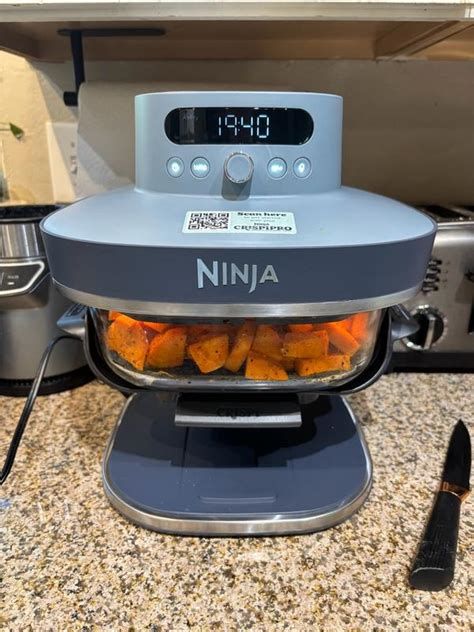
Why it matters: the easier the appliance is to clean, the more likely it will be used regularly instead of being relegated to the back of a cabinet.
How to maximize the advantage:
- Remove and soak heavily soiled baskets while the interior cools; most nonstick components are dishwasher safe but a quick pre-rinse reduces odors and baked-on residue.
- Empty and wipe the grease tray after every multi-item cook to avoid smoke and reduce grease buildup.
- Use soft brushes or non-abrasive pads to avoid damaging nonstick finishes, which prolong longevity and cook performance.
Pros & Cons
- Pros:
- Versatile cooking modes (crisping, roasting, dehydrating, reheating) expand kitchen capabilities.
- Multi-rack design enables efficient meal preparation and reduced cook times for multiple items.
- Probe compatibility improves doneness accuracy and food safety for proteins.
- Two-stage crisping reduces over-browning while delivering a crunchy finish.
- Thoughtful cleanup features and dishwasher-safe parts make it easy to maintain.
- Cons:
- Countertop footprint can be large for small kitchens—measure available space first.
- Learning curve: multi-rack and two-stage cooking require some experimentation for perfect results.
- Accessories like probes or extra racks may not be included with all bundles and could be an added purchase.
- Dehydration requires long run times and may not be ideal for users who need quick snacks.
Feature comparison
The table below provides a quick comparison between the Ninja Crispi Pro, a conventional single-basket air fryer, and a countertop convection oven. This helps buyers evaluate trade-offs related to capacity, functional versatility, and clean-up.
| Feature | Ninja Crispi Pro | Single-Basket Air Fryer | Countertop Convection Oven |
|---|---|---|---|
| Multi-level cooking | Yes — engineered airflow for two racks | Usually no — single basket only | Depends — larger models support multiple racks but airflow may vary |
| Probe support | Probe-compatible or probe-ready on many models | Often not supported | Some higher-end models support probes |
| Dehydrate/Restore modes | Yes — dedicated programs | Rare — typically limited to frying presets | Variable — some have dehydrate settings |
| Cleaning | Removable, dishwasher-safe parts and grease tray | Basket removable; dishwasher-safe options available | Removable trays but interior can be harder to clean depending on size |
| Countertop footprint | Medium-to-large; plan for space | Compact; good for small kitchens | Large; may double as primary oven for small spaces |
| Price range | Mid-to-high depending on bundle | Low-to-mid | Wide range; depends on capacity and features |
Buying guide: what to look for
Choosing the right model and bundle depends on how the appliance will be used. The following checklist helps buyers match the Ninja Crispi Pro to their real-world needs.
1. Assess usable capacity
Consider household size and typical meals. Families that often cook multiple items at once benefit from the Crispi Pro’s multi-rack capacity. Singles or couples who mostly reheat leftovers may prefer a smaller single-basket unit.
Shop the latest Electronics picks on Amazon.
View Offers →2. Verify included accessories
Check whether the model includes racks, a probe, or extra trays. A probe is especially useful for precise cooking of larger proteins. If these accessories aren’t included, factor in the cost of buying them separately.
3. Look for program variety
Presets are helpful, but the ability to customize temperature and time—and to use two-stage crisping—yields better results in the long run. Dehydrate and restore/reheat modes are useful extras for snack-makers and busy households.
4. Confirm cleaning and maintenance features
Dishwasher-safe components, an accessible grease tray, and a design that exposes the interior pockets for easy wiping reduce the time spent after cooking. Nonstick coatings extend convenience but require gentle cleaning to avoid wear.
5. Consider countertop fit and storage
Measure counter and storage space. If storage is tight, look for models with vertical profiles or folding handles. Remember to leave clearance for ventilation during operation.
6. Warranty, customer support, and replacement parts
Check warranty length and what it covers. A two-year warranty and readily available replacement parts (baskets, racks, probes) can be valuable for longevity, especially for frequently used appliances.
7. Noise and energy use
Some models run louder than others; for open-plan apartments or late-night cooking, noise matters. Energy consumption varies by wattage and cooking duration, so consider typical use patterns—multi-rack batches tend to be more efficient than multiple single batches.
Practical tips for everyday use
To help readers translate features into better meals, here are actionable tips that work with the Crispi Pro:
- Preheat briefly for frozen items to reduce cooking time and promote uniform crisping.
- Pat food dry before coating or seasoning—moisture is the enemy of crispness.
- Lightly oil foods that need extra color; the finishing blast will take care of the rest without excess oil.
- Batch cook during weekend meal prep: use the dehydrate function for snacks and the multi-rack for proteins and sides.
- Keep a small silicone brush and a non-abrasive pad near the sink to quickly scrub baskets before residues dry on.
Conclusion
The Ninja Crispi Pro is more than an air fryer alternative; when its lesser-known features are put to work it becomes a flexible kitchen ally. Two-stage crisping elevates texture, multi-rack cooking saves time and energy, probe compatibility ensures accuracy, dehydrate/restore modes expand use cases, and thoughtful cleanup design keeps the device in regular rotation. Buyers who focus only on presets and capacity may miss these enhancements that turn good results into great ones. For households that value texture, precision, and the ability to do more with a single countertop appliance, understanding and using these hidden features will make a noticeable difference in daily cooking.